TELOS sits between your agent and the model API. It rewrites each request so the parts that are genuinely stable keep hitting the KV cache, without changing a single byte the engine actually sees as semantically meaningful. You get there in three steps.
1

Install

# Linux / macOS / WSL2 / Android (Termux)
curl -fsSL https://raw.githubusercontent.com/learningCatHD/telos-sdk/main/scripts/install.sh | bash
Prefer pip?
pip install -U telos-sdk
Requires Python ≥ 3.10. See Installation for the from-source path and dependency details.
2

Connect

telos init
With no arguments, telos init will:
  • auto-detect which harness CLIs are installed locally (claude-code / codex / openclaw / hermes),
  • inject config pointing each at the local gateway,
  • start the gateway in the background (state in ~/.telos/gateway.json),
  • print the gateway and dashboard addresses.
No changes to your agent code, no changes to PATH, and npm update won’t lose it.
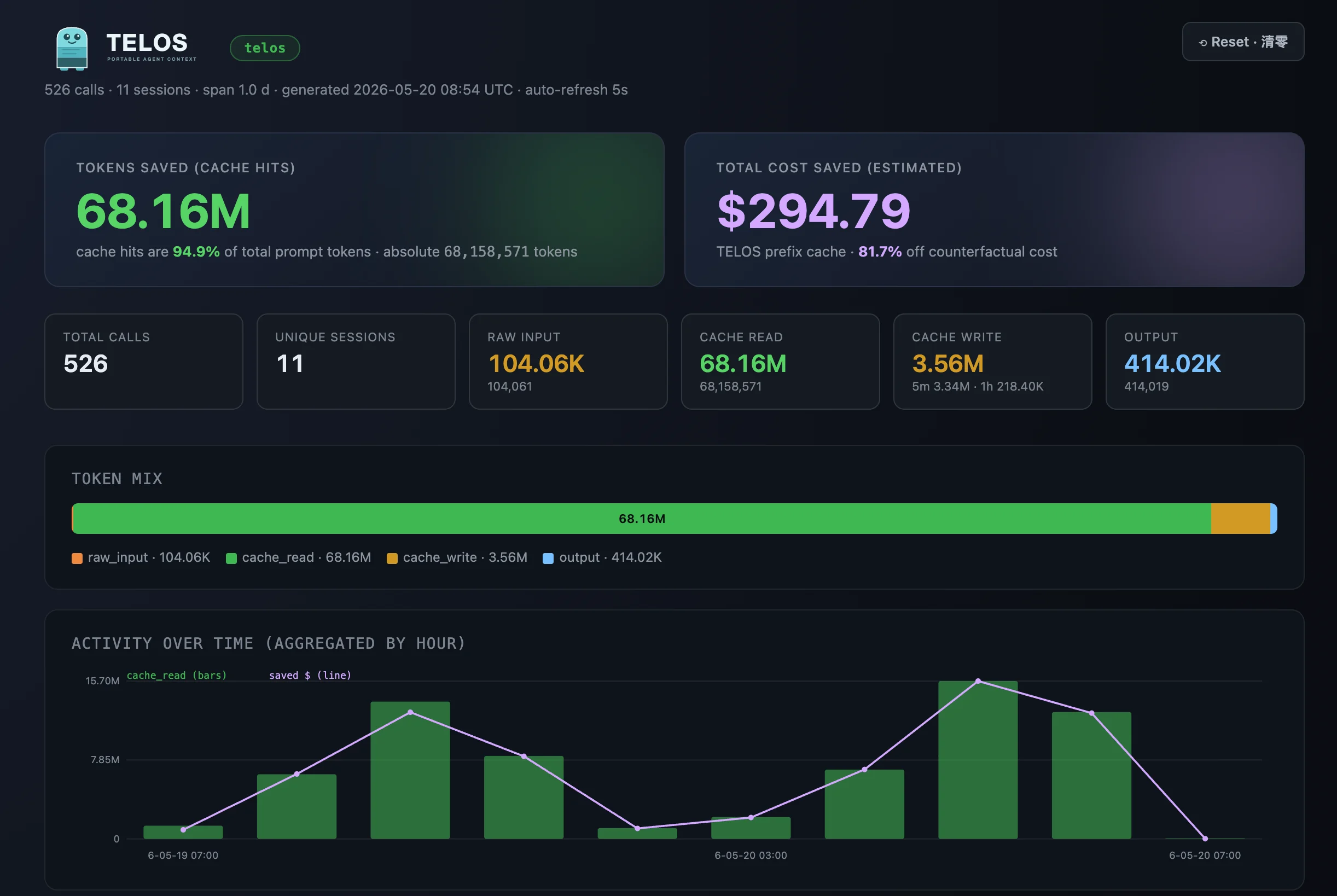
3

Observe

telos dashboard
Opens an offline HTML dashboard in your browser showing savings per call in absolute dollars. Every invocation is appended to ~/.telos/usage.jsonl and aggregated in real time.
TELOS savings dashboard

After telos init

telos              # pick a harness and enter its CLI
telos dashboard    # open the live dashboard in the browser
telos mode both    # switch the optimization gear, hot-reloading the running gateway
telos gateway status   # check the gateway's run status

Choose your integration path

There are two functionally equivalent ways to route traffic through TELOS.

Path B · Proxy gateway

Zero-intrusion. Point ANTHROPIC_BASE_URL at the local gateway — no code changes. This is what telos init sets up. Recommended.

Path A · SDK transport

In-process. Swap your anthropic.Anthropic() / openai.OpenAI() client for the TELOS transport; every .create() call stays the same.

Next steps

The Protocol

Understand why the cache can’t break.

Three-color bands

PIN / FOLD / DROP, explained.

Support Matrix

Which harnesses, models, and frameworks are covered.
Don’t trust the percentages — TELOS is open source. Run it on your own workflow and see whether that 92% is real, or just another “X× tokens” claim.